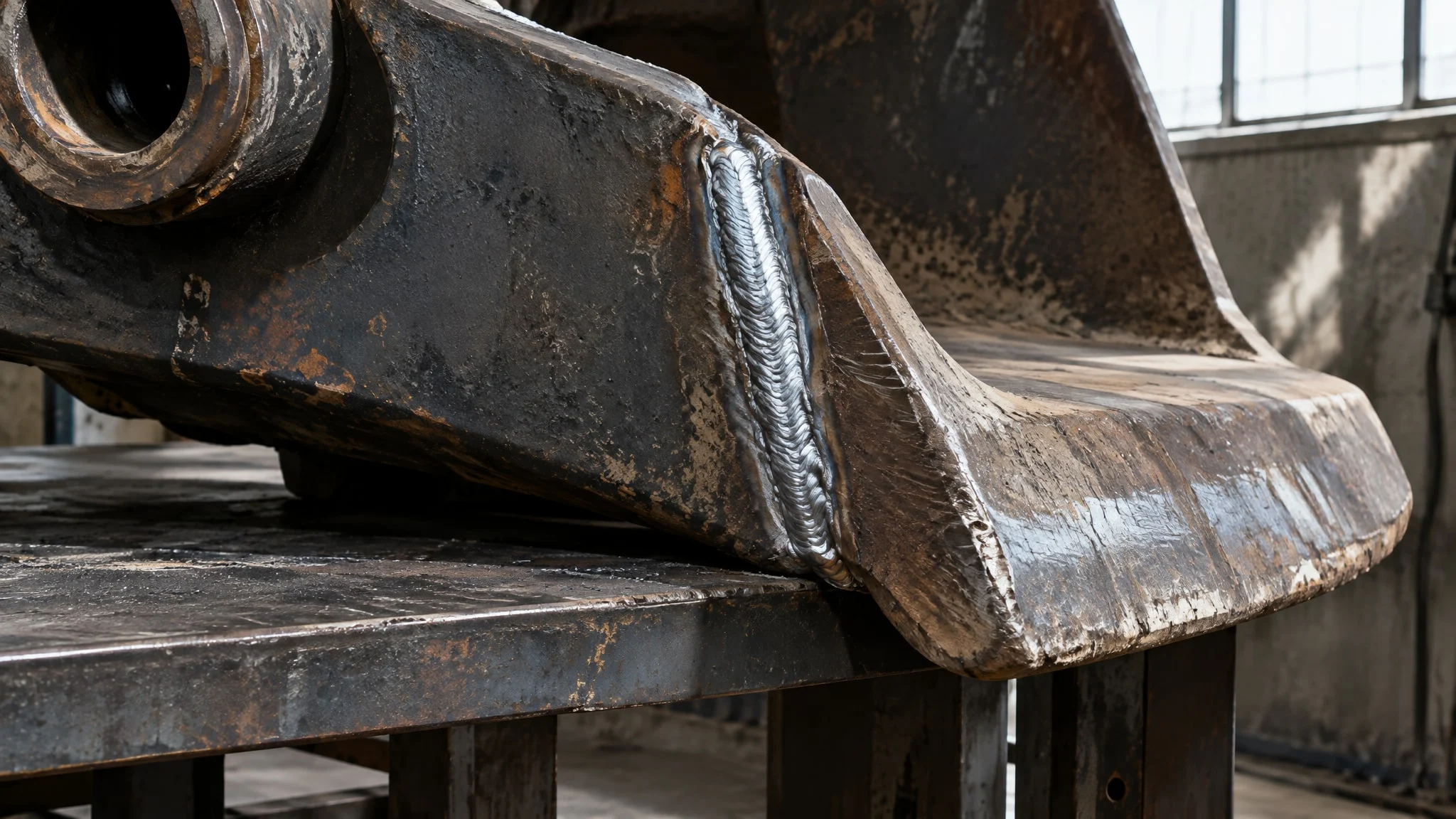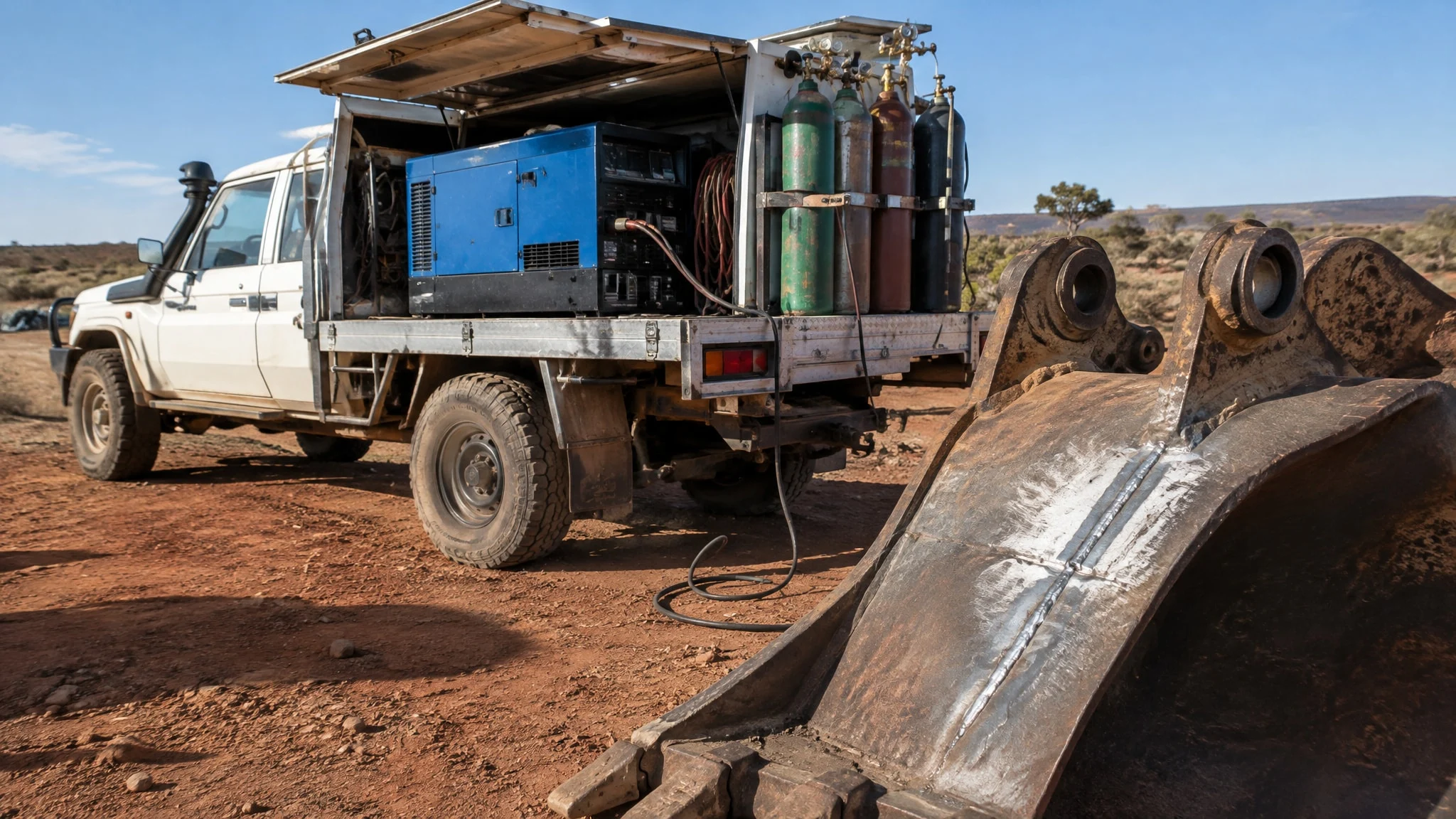
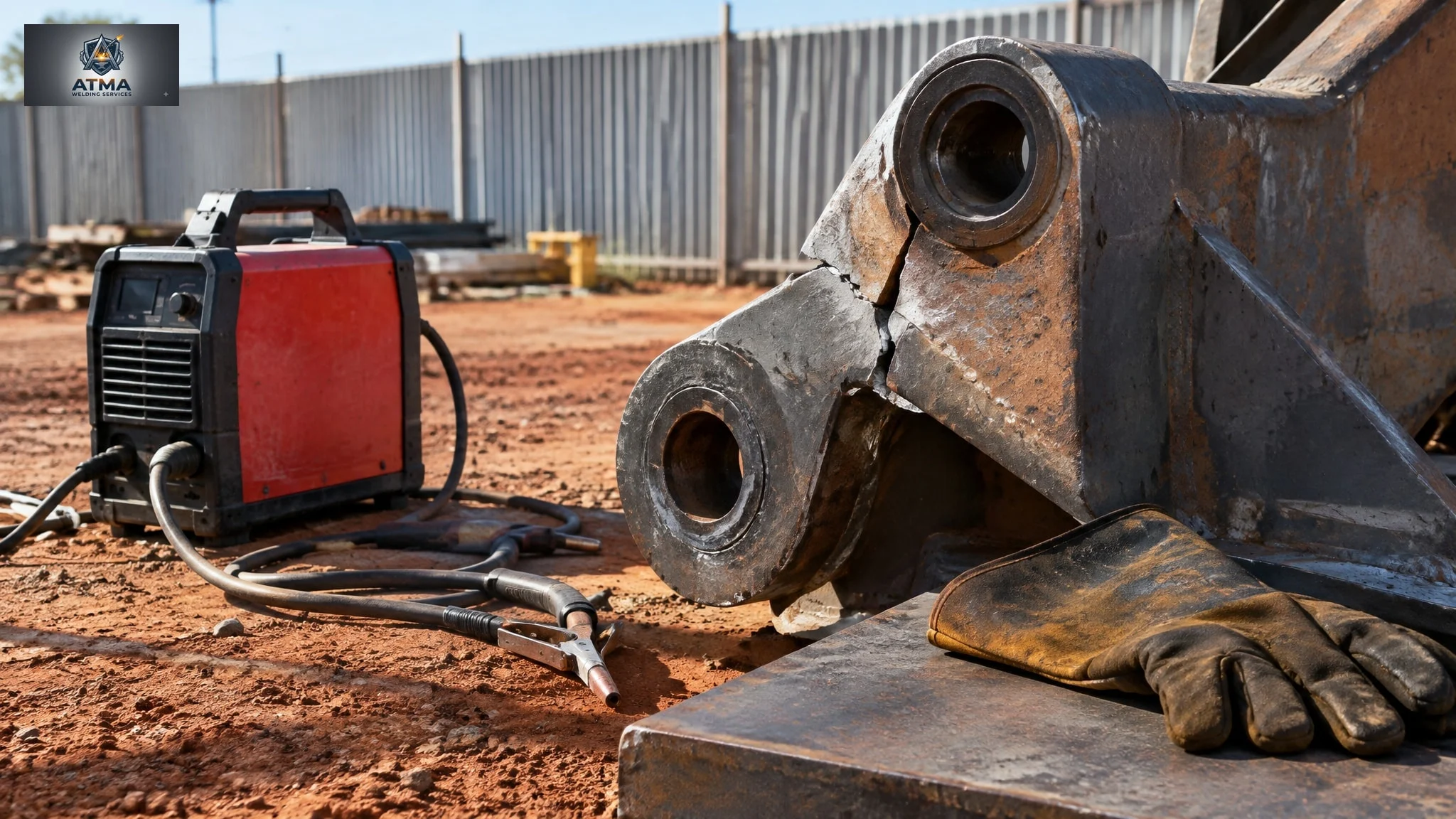
When a machine stops, the whole job stops with it. I’m Alex, and I’ve spent more than 20 years getting stopped equipment working again, from farm gear to mining plant. This page explains how I handle emergency welding repairs in Perth and across WA, and what happens between your first call and the machine running again.
What counts as an emergency welding repair
An emergency welding repair fixes a cracked, broken or failing weld or component that has stopped equipment working or made it unsafe to run. That’s the test I use. If the machine can’t do its job, or you wouldn’t trust it with an operator on board, it’s a breakdown.
A hairline crack you spotted at a service is different. It still needs fixing, but it can usually go on a planned job. A boom pin bracket that has torn off mid-shift can’t wait.
If you’re weighing up whether a mobile repair suits your situation, the wider picture of onsite welding is covered at the end of this page.
Emergency welding repairs in Perth, carried out onsite
Most competitors want the machine brought to their workshop. I do it the other way round: I bring the welding to the machine, so the repair starts where the machine stopped. That removes transport, loading and waiting from the job before a single arc is struck.
“Fast” here describes the process, not a promised arrival time. I won’t quote you a figure I can’t stand behind, because distance, access and the damage itself all change the answer. What I can promise is that I’ll tell you straight what the job needs once I know what failed.
How a breakdown call-out works onsite
Every call-out follows the same basic steps, whether it’s a tractor on a farm or a loader on a mine site.
- The call. You tell me what failed, where the machine is and whether anyone’s been hurt or is at risk. I’ll ask a few questions so I turn up with the right gear.
- The details. I take the machine type, the location, a description of the damage and how the site is accessed. Photos help a lot if you can send them.
- Access and safety check. When I arrive, I look at where the machine sits, the ground, overhead hazards and who’s working nearby. The machine gets isolated before any hot work starts, so nothing can move or start while I’m in there.
- The repair in place. I prepare the damaged area, cut out anything that’s cracked through or worn thin, and weld it back to suit the load it carries.
- Ready-to-run check. Before I leave, I check the repair over and talk you through what I did, so your operator knows what’s been done and what to keep an eye on.
If a breakdown has you stuck right now, use the quote form at the end of this page and give me as much detail as you’ve got. The more I know up front, the less time I spend working it out on site.
After-hours breakdown welding in Perth
Machines don’t fail on a 7 to 3 schedule. A track frame lets go at dusk, a gate hinge on a stock yard snaps on a Sunday, and the next morning’s work depends on it.
If you need an after hours welder in Perth, say so when you get in touch, and tell me it’s out of hours. I’ll confirm with you directly what I can do for that job and when, rather than have you rely on a blanket promise on a web page. The details that matter most are the same as any call-out: what failed, where the machine is, and whether it’s safe to leave overnight.
You’ll get a straight answer from me on what’s realistic. If a repair is better done in daylight for safety reasons, I’ll say so.
Breakdown welding service for earthmoving and mining equipment
Heavy equipment is where most of my background sits. I’ve worked on mining equipment overhauls, oil and gas projects including Wheatstone and Ichthys, tunnel boring machine work and plenty of agricultural gear. That mix means I’ve seen what happens when large machines work hard, and what a repair needs to do to survive the same abuse again. My breakdown welding service for earthmoving and mining equipment starts with that experience, not with a price list.
For the wider detail on overhaul work, there’s more on mining equipment welding repairs in WA.
Common breakdowns on earthmoving and mining machines
The same parts fail again and again, because they take the heaviest loads and the most vibration.
- Cracked booms and arms, often starting at a weld toe or around a pin boss.
- Buckets with split sidewalls, worn lips or torn-out wear plates.
- Brackets and linkages that have sheared or cracked after repeated shock loading.
- Frames and chassis members with fatigue cracks that have grown over time.
When a section is too damaged to repair as it is, I cut it out first. Oxy and plasma cutting let me remove cracked or worn metal cleanly, so the new weld goes into sound material instead of over the top of the problem. Welding over a crack without removing it is a quick way to be back on site in a fortnight.
Picture a typical case: a bucket linkage cracks on a machine working in a pit. The first question isn’t how fast I can weld it. It’s whether the machine can be welded where it sits, safely, or whether it needs to move first.
Repairing in place or moving the machine
Many breakdowns can be welded in place when access and safety allow. That’s my preference, because moving a large machine to a workshop usually means arranging transport before any welding starts, and that adds time to a stopped job.
Three things decide it:
- Access. Can I reach the damage, and can I get gear and a clear working space around it?
- Safety. Is the ground stable, is the machine properly isolated, and are there overhead or fire hazards nearby?
- Repair setup. Does the repair need heat control, positioning or jigging that can’t be done in the field?
If the answer to any of those is no, the machine may need to come to me. Not every repair belongs in a paddock or a pit, and I’d rather tell you that early than do a job in a spot where I can’t do it properly.
Keeping downtime short without unsafe shortcuts
Downtime is the real cost of a stopped machine. The repair bill is one thing, but idle operators, delayed jobs and hired replacement gear add up fast, and you feel every hour of it.
A quicker return to work comes from making the right call early, not from cutting corners. Correct diagnosis, the right prep, a weld done to suit the load and a proper check at the end keep the machine running longer than a rushed patch does. A rushed patch that fails again is the slowest repair of all.
You can help shorten the job too. Clear access around the machine, a safe spot for me to park and someone on site who knows what happened all save time before I’ve struck an arc.
Temporary weld or permanent repair
Sometimes a temporary weld is the sensible move. If a machine can be made safe enough to travel to a planned repair, a temporary weld gets it moving under its own power or onto a float, so the permanent job happens where it can be done properly.
A temporary weld is not a permanent repair, and I won’t dress it up as one.
Some machines shouldn’t run at all. If the damage affects a load-bearing part, a lifting point or anything an operator’s safety depends on, I’ll tell you to stand the machine down. I know that’s not what you want to hear on a busy day, but a stood-down machine is a lot cheaper than an injury.
Certified structural welding for breakdown repairs
Structural breakdown repairs carry load, and often people. A boom, a chassis rail or a lifting bracket that fails after a bad weld can hurt someone, so these repairs need a qualified welder who understands how the joint is stressed, not just how to join two bits of steel.
I’m a certified tradesman with over 20 years of hands-on experience, working in the trade since 2002. I run ATMA Welding Services myself, so the person who takes your call is the person who turns up and does the work.
I won’t claim more than I can back up. This is a one-man trade business built on the work itself, so the best way to judge it is the track record. You can browse recent work to see the kind of repairs and fabrication I do, before you ever pick up the phone.
Urgent welding repairs across Perth, the Hills and regional WA
For urgent welding repair in WA, I work from Walliston in the Perth Hills and travel to where the machine is. That covers metro Perth, the Hills and regional Western Australia, on farms, quarries, mine sites and building sites alike.
Metro jobs are straightforward: I load up and come to you. Regional jobs take more planning, because distance affects what I bring and how the day runs. I don’t put travel times on a web page, since they depend on where you are and what else is on. Give me your location when you get in touch and I’ll tell you what’s realistic.
For a regional breakdown, I’ll ask about the machine, the damage and what facilities you’ve got on site, such as power, shelter and a flat working area. That lets me bring the right equipment the first time, which matters when the nearest supplier is hours away.
I can’t be everywhere at once, and a job that’s sitting on a stopped machine gets looked at first. If I’m already committed, I’ll tell you rather than leave you guessing.
Request a breakdown repair quote
If you’ve got a machine down or a repair you can see coming, the quickest way to get moving is to Request a quote. Tell me what’s happened and I’ll come back to you with what the job needs.
Still comparing options? Learn more about mobile welding for onsite repairs and how it compares with a workshop-only repair.
What to have ready when you call
A quote request is quicker to act on when I can picture the job before I get there. Have these on hand:
- The machine make and model.
- Where it is, including the property or site name and nearest town.
- What failed, in your own words, with photos if you can.
- Whether the machine can be moved safely.
- Site access: gates, ground conditions, and anything that might limit a ute or trailer.
Don’t worry if you can’t answer everything. Send what you’ve got and I’ll ask for the rest.
Frequently asked questions
Can you do emergency welding repairs onsite, or does the machine have to come to a workshop?
I attend breakdowns onsite across Perth, the Perth Hills and regional WA, so the repair can start where the machine stopped. Some jobs still need to come to the workshop if access, safety or the repair setup rules out working in the field. I’ll tell you which applies once I know what failed.
Can a cracked boom, arm or bucket be welded without moving the machine?
Often, yes. Cracked booms, arms, buckets, brackets and frames can be welded in place when access and safety allow. Damaged sections are cut out first, using oxy or plasma cutting, so the new weld goes into sound metal.
Is it safe to run a machine on a temporary weld?
A temporary weld can get a machine moving safely to a planned repair, but it isn’t a permanent fix. If the damage is on a load-bearing part, a lifting point or anything operator safety relies on, the machine should be stood down rather than run.
How do I raise an after-hours breakdown?
Get in touch, say it’s out of hours, and give me what failed, where the machine is and whether it’s safe to leave overnight. I’ll confirm directly what I can do for your job and when. Photos help me plan before I arrive.
Do you travel to regional WA for urgent repairs?
Yes. I work from Walliston and travel across regional Western Australia. Send your location and what’s on site, such as power and a flat working area, and I’ll tell you what’s realistic for your job.